

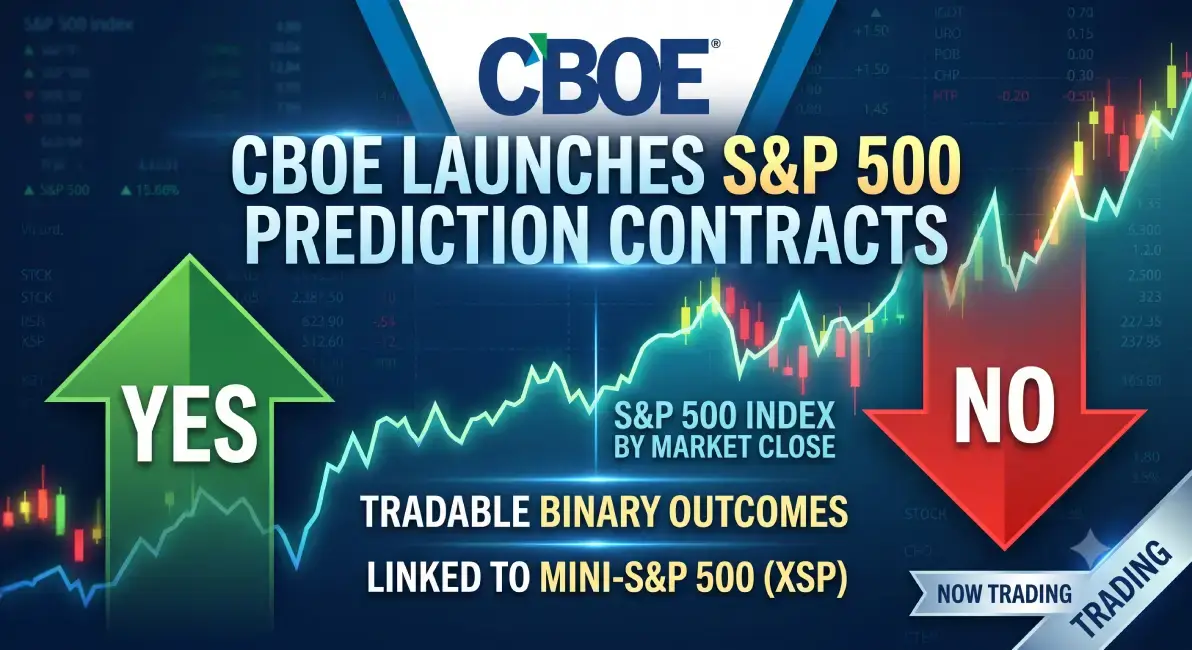
Wall Street has a new crystal ball, and this time, it comes with a straightforward fixed payout. On June 23, 2026, Cboe Global Markets effectively blurred the line between traditional options trading and outcome-based forecasting by launching Cboe Predicts.
By introducing the Cboe prediction market with yes-or-no contracts tied to the S&P 500, the derivatives giant is bringing simple, event-based trading to the mainstream financial world. It is a bold move that is set to democratize market speculation—but what exactly does this mean for retail traders and the broader financial ecosystem?
How Cboe’s S&P 500 Prediction Contracts Work
At the core of this new offering are binary option contracts based on the Mini-S&P 500 Index (XSP), which is scaled to 1/10th the size of the standard SPX. Listed under the symbols XSPBW and XSPBX, these contracts strip away the complex math of traditional options—like calculating Delta, Theta, or Implied Volatility—and replace it with a simple, defined-risk question: Will the S&P 500 close above a specific level today?
Traders simply take a “yes” or “no” position:
If you are right: The contract pays out $100.
If you are wrong: The contract pays out $0.
Your total risk is strictly limited to the premium you paid to enter the trade, making it an incredibly transparent way to hedge a portfolio or speculate on daily market movements.
Where Are the Contracts Trading Right Now?
Because these prediction contracts operate under the existing U.S. options regulatory framework and are centrally cleared by the Options Clearing Corporation (OCC), they require reputable brokerage access.
Currently, the Cboe prediction market contracts are live and actively trading on Interactive Brokers. For everyday retail investors, this means immediate access to institutional-grade liquidity. Looking ahead, the footprint is poised to expand aggressively. Charles Schwab has already announced plans to roll out access to these binary options in the coming months. Over the next 6 to 12 months, expect a domino effect as other major retail brokerage platforms integrate the product to keep pace with customer demand.
A Brief History of Prediction Contracts
To appreciate the gravity of Cboe’s launch, you have to look at the fascinating evolution of prediction markets. For years, outcome-based trading was largely viewed as an academic experiment (like the Iowa Electronic Markets) or relegated to the fringes of sports betting and political polling.
Recently, the concept exploded in popularity through crypto-native platforms like Polymarket, and regulated fintech startups like Kalshi. These platforms proved that there is massive public appetite for trading on real-world outcomes. However, Cboe has taken this revolutionary concept and dragged it onto the main stage of traditional finance. By confining the market to financial benchmarks rather than pop culture or politics, Cboe has legitimized the prediction contract for the everyday stock market investor.
The Massive Financial Opportunity
For Cboe, this launch is a calculated financial masterstroke. In recent years, zero-day-to-expiration (0DTE) options have taken the market by storm, generating unprecedented daily trading volumes. The Cboe prediction market is the natural evolution of this trend. It captures the massive demographic of retail traders who crave short-term, outcome-based trades but are intimidated by standard options chains.
For investors, the opportunity is equally profound. These contracts offer a hyper-efficient way to trade macroeconomic news, earnings reports, or Federal Reserve announcements without risking unlimited downside or buying shares of an underlying index.
Ultimately, Cboe is betting that the future of finance lies in simplicity. By merging the intuitive nature of prediction markets with the fortress-like security of traditional exchange clearing, Cboe Predicts isn’t just a new product—it is the blueprint for how retail investors will engage with market volatility for decades to come.





Leave a Comment
You must be logged in to post a comment.