
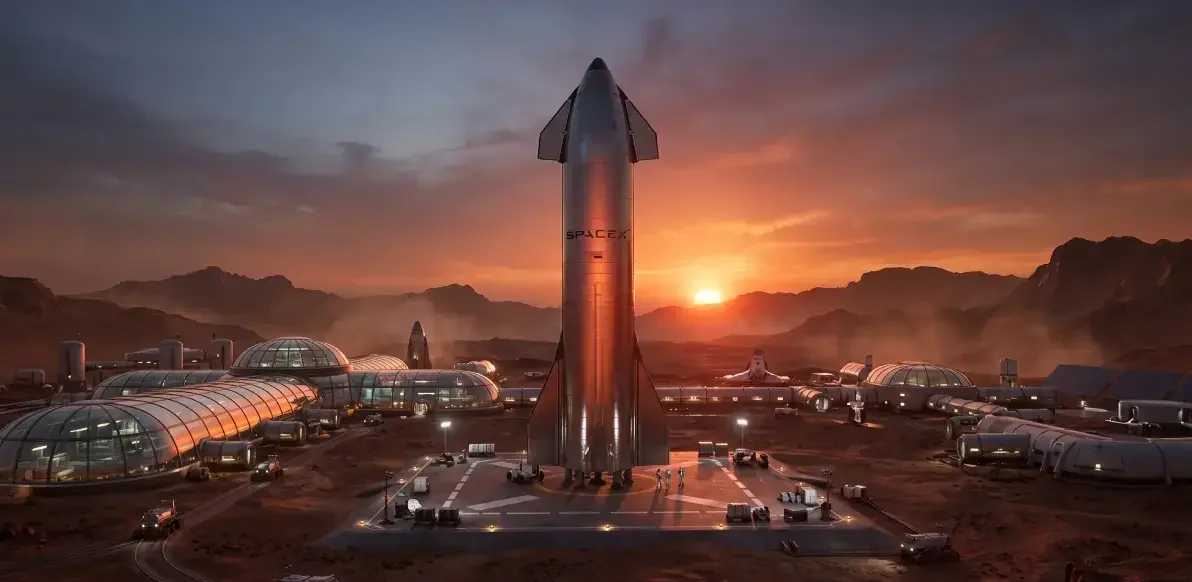
On June 12, 2026, SpaceX debuted on the Nasdaq under the ticker SPCX, executing the largest initial public offering (IPO) in history. As of mid-June 2026, the stock surged past the $200 mark, crushing its $135 IPO price and driving the company’s market capitalization to between $2.58 and $2.75 trillion. At the time this article was written, June 19th, 2026, SpaceX (SPCX) shares were trading hands at $185.
The hype is undeniable, but investing in a company trading at 130x historical sales requires looking past the immediate market euphoria. Here is a deep dive into SpaceX’s newly structured corporate empire, its financial reality, its five-year projections, and actionable entry points for long-term investors.
The New Empire: Space, Connectivity, and AI
The SpaceX S-1 prospectus provides an unprecedented look inside Elon Musk’s empire, which has now structurally integrated X (formerly Twitter) and xAI under its corporate umbrella. While the core mission remains making life multiplanetary, SpaceX has evolved into a vertically integrated innovation engine operating across three major segments:
Space: The company operates the Falcon family of rockets, maintaining an over 99% mission success rate and launching more than 80% of the world’s mass to orbit since 2023.
Connectivity: SpaceX operates the world’s most advanced broadband network, Starlink, boasting approximately 10.3 million subscribers across 164 countries and territories. Additionally, its satellite-to-mobile constellation serves roughly 7.4 million monthly unique devices. (Accounting for 61% of SpaceX total revenue and the only unit with an operating profit ($4.42 billion))
Artificial Intelligence: Leveraging xAI, SpaceX became the first company to deploy a gigawatt-scale AI training cluster, known as COLOSSUS. This infrastructure powers its truth-seeking frontier model, Grok, which benefits from real-time data integration with X’s 550 million monthly active users.
The Financial Reality Check
While SpaceX generates massive revenue, it remains heavily unprofitable at the consolidated group level due to the immense capital required to simultaneously fund Starlink, Starship, and massive AI data infrastructure.
In 2025, SpaceX generated $18.67 billion in full-year revenue, representing a 33% increase from $14.1 billion in 2024. The company also reported $6.58 billion in Adjusted EBITDA for 2025. However, it recorded a net loss of $4.94 billion for the year, a sharp swing from its $791 million profit in 2024. By Q1 2026, revenue reached $4.69 billion, but net losses widened to $4.27 billion for the quarter alone, driven by aggressive AI capital expenditures.
Objectively, standard financial metrics suggest that a $2.58 trillion valuation is an aggressive and speculative reach. The market is effectively valuing SpaceX not as a traditional company, but as an index fund for the entire future of human infrastructure.
The Next 5 Years: The $1 Trillion Thesis
Following the SpaceX stock IPO, Elon Musk posted on X claiming that the company could reach $1 trillion in annual revenue by 2030. Wall Street analysts, however, view this target as a monumental long shot. To reach this milestone, SpaceX’s revenue would need to multiply by roughly 53 times in just five years, requiring an unprecedented, explosive growth trajectory.
Where would this massive revenue come from? Traditional space operations are not a large enough market to support a trillion-dollar revenue stream. Instead, the path to $1 trillion relies heavily on the “Orbital Compute Thesis“. This concept involves utilizing SpaceX’s satellite constellation to deliver edge AI computing at scale, sidestepping the power constraints of terrestrial data centers.
Internal company documents estimate a total addressable market of $28.5 trillion, with approximately 90% tied to AI-related opportunities rather than standard rockets or broadband. While institutions like Goldman Sachs model SpaceX’s 2030 total revenue at around $474 billion—with $322 billion expected from AI alone—hitting Musk’s $1 trillion target demands flawless execution of this entirely new orbital AI compute business model.
Strategic Entry Points: Navigating the Hype
Because SpaceX is a highly volatile, hype-driven mega-cap, attempting to execute a single lump-sum purchase above $200 per share is incredibly risky. A prudent entry would require a Staged Dollar-Cost Averaging (DCA) strategy tied to specific corporate and market events:
Zone 1: The Tactical Momentum Chase ($175 – $190): Market participants may be interested in deploying 25% of their allocation here to ride forced passive buying. Nasdaq modified its rules to allow SpaceX “fast entry” into the Nasdaq-100 index in early July 2026, which will force index funds and ETFs to mechanically buy between $8 billion and $30 billion worth of SPCX. This institutional buying will likely act as a structural price floor.
Zone 2: The Institutional Value Floor ($150 – $160): Market participants may be interested in deploying 35% of their allocation in this zone. This targets the post-Q2 earnings stabilization period.
Zone 3: The Lock-Up Expiry ($135): Market participants may be interested in deploying their final 40% here. Returning to the $135 IPO price capitalizes on the massive 180-day lock-up expiration occurring on December 8, 2026. Mega-IPOs historically face severe downward pressure during this time, as early employees and venture capital backers finally have the opportunity to cash out their illiquid private shares.
Thoughts Moving Forward
SpaceX’s debut on the public markets offers investors a chance to own a piece of humanity’s multiplanetary and AI-driven future. However, extreme valuation multiples leave zero margin for error. Furthermore, the entire premium relies on Musk’s operational execution across SpaceX, Tesla, xAI, and X, introducing significant key-man concentration risk. By utilizing a disciplined, staged entry strategy, investors may be able to navigate the post-IPO volatility and position themselves for the next era of industrial expansion.


Leave a Comment
You must be logged in to post a comment.