We are witnessing a historical disconnect in the artificial intelligence sector. On Wall Street, semiconductor firms are printing money as if the AI gold rush has no ceiling. Meanwhile, deep inside the data centers of the world’s largest tech conglomerates, a very different reality is quietly taking shape. The narrative of infinite demand is beginning to crack.
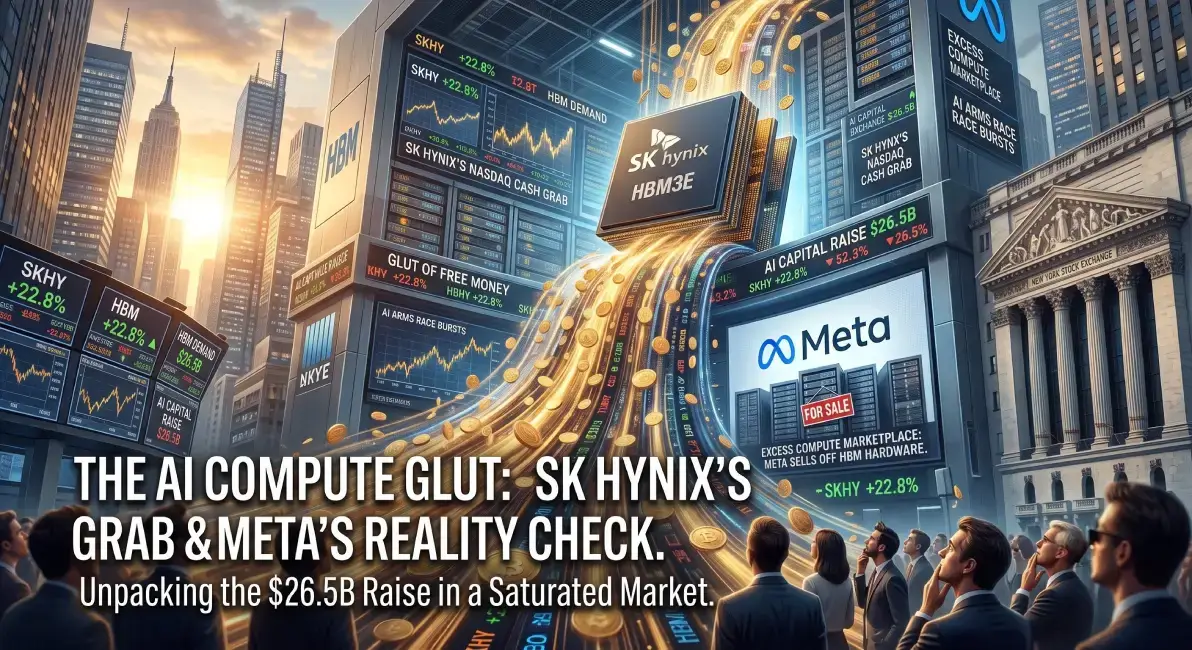
Nothing illustrates this paradox better than the recent juxtaposition of two major tech events. First, South Korean memory giant SK Hynix pulled off a staggering U.S. equity raise, perfectly timing the market’s insatiable appetite for AI hardware. Second, and far more concerning for the broader industry, Meta Platforms began exploring ways to sell off its excess AI compute capacity.
Let us break down why this glut of free money is still flowing, and why the big picture might be far unlikelier than investors want to admit.
The SK Hynix ADR: A Masterclass in Cashing In
In early July 2026, SK Hynix made waves by raising an eye-watering $26.5 billion through its American Depositary Receipt (ADR) offering on the Nasdaq. To understand the sheer scale of this cash grab, you have to look at the mechanics of the deal. Each ADR represents just one-tenth (1/10th) of a single ordinary common share listed in Seoul. Shares are set to trade on the Nasdaq today, July 10th, 2026.
By packaging fractional shares for American investors, SK Hynix tapped directly into a seemingly bottomless well of U.S. capital. And the market devoured it. Orders reportedly exceeded available shares by seven times (good lord…), proving that the “glut of free money” is still very much alive for companies manufacturing high-bandwidth memory (HBM) chips.
Investors are willingly paying a premium because they believe the AI infrastructure buildout is a permanent, unstoppable force. But this massive influx of capital into hardware makers is creating a dangerous illusion. It assumes that the end buyers—the massive hyperscalers—will continue buying chips at this velocity forever.
The Glut of Free Money in the AI Industry
The semiconductor industry is currently benefiting from an unprecedented era of free-flowing capital. Because AI is viewed as an existential arms race, traditional valuation metrics have been thrown out the window. Venture capital, institutional money, and retail investors are all pouring billions into any company that produces the picks and shovels for the AI ecosystem.
Consequently, companies like SK Hynix can execute never-ending raises. They can issue new shares, dilute equity, and demand massive premiums, all while the market applauds. The prevailing logic is simple: more capital equals more manufacturing capacity, which equals more chips to sell to tech giants desperate for compute power.
However, this “infinite demand” thesis relies entirely on one massive assumption. It assumes that the hyperscalers actually need every single chip they are buying, and that they are generating a profitable return on their monumental infrastructure investments.
The Reality Check: Meta Platforms Sells Excess AI Compute
This brings us to the elephant in the room. If the demand for AI compute is truly insatiable, why is Meta Platforms—one of the largest buyers of AI hardware on the planet—looking to offload its spare capacity?
Recent reporting reveals that Meta is actively developing plans to sell access to its excess AI computing power and models. By potentially pivoting toward a cloud infrastructure business, Meta would directly compete with Amazon Web Services (AWS), Microsoft Azure, and neocloud providers like CoreWeave.
On the surface, this might look like a clever monetization strategy. But if you read between the lines, it signals a massive shift in the AI narrative. Mark Zuckerberg previously committed hundreds of billions of dollars to secure AI infrastructure, effectively hoarding compute capacity to ensure Meta would not be left behind. Now, the company has realized it possesses an AI compute glut. It has more infrastructure than it can profitably use for its internal consumer products.
Why the Big Picture is Unlikely
Meta’s pivot should serve as a massive red flag for the entire AI hardware supply chain. It suggests that the big picture—a world where hyperscalers buy hardware at an exponential rate forever—is fundamentally unlikely.
When a major buyer transitions into a seller, the market dynamics shift drastically.
- The ROI Problem: Hyperscalers are facing immense pressure from Wall Street to show a return on investment for their massive capital expenditures. Selling excess compute is a defensive attempt to recoup these sunk costs.
- The Overbuild: If Meta is experiencing a compute glut, it is highly probable that other tech giants are sitting on underutilized data centers as well.
- The Ripple Effect: Once the hyperscalers stop hoarding chips and start optimizing their existing capacity, the bottomless demand that fueled SK Hynix’s $26.5 billion raise will evaporate.
Conclusion: The End of the Infinite Money Glitch
The AI revolution is undoubtedly real, but the economics funding its current hardware phase are becoming increasingly detached from reality. SK Hynix’s wildly successful ADR debut—where investors fought to buy just one-tenth of a share—is a testament to the sheer volume of speculative money still sloshing around the system.
Yet, Meta Platforms’ quiet move to rent out its excess compute tells the true story. The AI compute glut is already here. The never-ending raises and the glut of free money may persist for a few more quarters, but the structural foundation is showing cracks. Investors betting that the hardware hoarding will continue indefinitely may soon find themselves holding the bag when the hyperscalers finally say, “We have enough.”



Leave a Comment
You must be logged in to post a comment.