
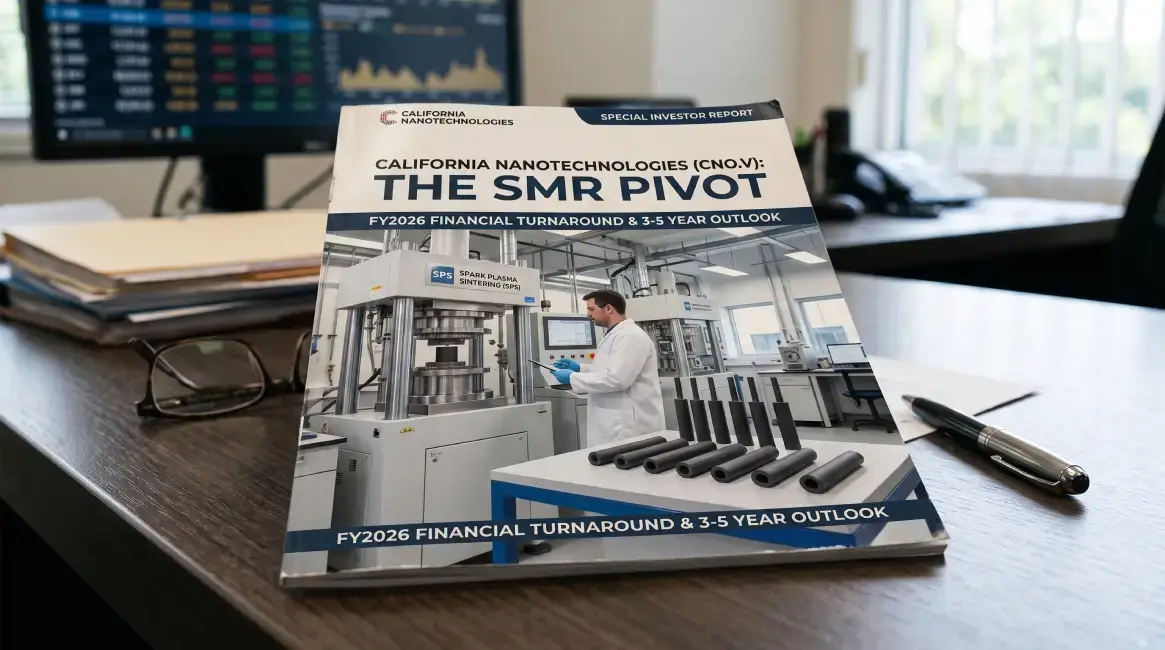
Introduction: The Catalyst of Transformation
In the highly specialized world of advanced metallurgy and material science, micro-cap companies are rarely afforded the opportunity to position themselves at the center of a global macroeconomic shift. Yet, California Nanotechnologies Corp. (TSXV: CNO) finds itself doing exactly that. Exiting a turbulent fiscal year in 2026, the company has completed a sweeping strategic pivot, shifting its core operations away from a concentrated legacy client base and moving aggressively into the Small Modular Reactor (SMR) supply chain.
This analysis examines the mechanics of Cal Nano’s operational transition, diving deeply into the FY2026 financial turnaround, balance sheet health, internal liquidity metrics, and the aggressive insider buying that signals management’s absolute conviction in this new trajectory. Furthermore, we outline the company’s financial prospects and stock performance over the next 3 to 5 years, establishing rational technical zones for both potential accumulation and profit-taking.
The Small Modular Reactor (SMR) Pivot: A High-Margin Frontier
The global push for clean, reliable baseload energy has ignited unprecedented capital investment in Small Modular Reactors (SMRs). Unlike traditional gigawatt-scale nuclear plants that take decades and billions of dollars to build on-site, SMRs are designed to be manufactured in facilities and assembled on location. This modularity brings down costs but introduces severe engineering challenges: smaller reactor cores mean substantially higher thermal and radiation densities. Traditional forged metals degrade quickly in these environments.
This is where California Nanotechnologies steps in. The company leverages a proprietary manufacturing technique known as Spark Plasma Sintering (SPS). Utilizing high-amperage electric currents and extreme mechanical pressure, SPS fuses advanced metal and ceramic powders into ultra-high-density components. This process is essential for creating the radiation-tolerant materials required for SMRs, particularly Boron Carbide (B₄C) control rods, which absorb neutrons to safely regulate nuclear fission.
The ultimate validation of this technology came in late 2025. After successfully passing rigorous technical specifications, Cal Nano secured its first commercial purchase orders—valued at approximately US$196,250—to manufacture high-density boron-carbide reactor control rods for a prominent U.S. advanced reactor developer. This order signaled the official transition from a theoretical R&D facility to a commercial-scale tier-one SMR supplier.
FY2026 Financial Turnaround: Addition by Subtraction
To the casual observer, Cal Nano’s FY2026 financial report (for the year ending February 28, 2026) might look alarming on the surface. Headline revenues dropped by a staggering 55% from the previous year, falling to US$2.79 million, accompanied by a net loss of US$1.86 million. However, seasoned investors recognize this as a classic “addition by subtraction” turnaround.
During FY2025, Cal Nano had achieved record revenues of US$6.22 million, but those figures were dangerously reliant on a single “green steel” client. When that client rolled off, the revenue cliff was severe. But beneath the headline drop, the structural core of the business was drastically improving. Manufacturing revenues excluding the green steel customer surged by an impressive 85% year-over-year, reaching US$2.63 million.
“The turning point arrived in the fourth quarter of FY2026. As high-margin shipments of SMR components began to scale, the company posted a positive Adjusted EBITDA of US$50,329, marking the official end of the transitional trough and the beginning of a new growth cycle.”
Analyzing the Balance Sheet and Efficiency Metrics
A corporate pivot is only as successful as the balance sheet that supports it. A deep dive into California Nanotechnologies’ liquidity and efficiency ratios reveals a lean operation capable of handling increased purchase order volumes without risking immediate dilution or debt insolvency.
Debt-to-Equity Ratio (0.65 – 0.71)
For a capital-intensive manufacturer operating multi-million dollar SPS presses, a D/E ratio under 1.0 is exceptional. Hovering between 0.65 and 0.71, Cal Nano uses roughly 66 cents of debt for every dollar of equity. This clean balance sheet gave management the breathing room needed during the green steel drop-off. Bolstered by a CA$935,900 private placement in March 2026, the company can fund its SMR scale-up without taking on high-interest, toxic debt.
Quick Ratio (~0.85 to 0.86)
While slightly below the traditional ideal of 1.0, an 0.86 quick ratio is perfectly standard for a specialized manufacturer. This metric excludes inventory. To execute its nuclear contracts, Cal Nano must maintain a steady supply of highly specialized raw powders (like Boron Carbide). When inventory is factored back in, the Current Ratio rises to ~1.0, indicating sufficient short-term liquidity.
Free Cash Flow (-US$430,690)
The trailing negative free cash flow was the expected cost of the FY2026 pivot. Absorbing fixed overhead while qualifying for new advanced nuclear contracts burned cash. However, with operating cash flow stabilizing and Q4 returning to positive Adjusted EBITDA, this cash burn represents the financial trough. As SMR deliverables increase, FCF is expected to trend positively through FY2027.
Days Sales of Inventory (13.5 Days)
A DSI of 13.5 days (Inventory Turnover of 27.09) is exceptionally lean for industrial manufacturing. This proves Cal Nano is operating a strict contract-driven, just-in-time production model. Powders are procured specifically for secured POs, and the rapid Spark Plasma Sintering process turns that raw material into accounts receivable faster than traditional forging ever could.
The Ultimate Vote of Confidence: Insider Buying
In the micro-cap space, executives can issue optimistic press releases endlessly, but open-market capital allocation tells the true story. The insider buying at California Nanotechnologies over the trailing 12 months has been aggressively net-positive, signaling immense internal confidence in the SMR pivot.
Interim CFO and Board Member Roger Dent has been a primary accumulator. In October 2025, he exercised options for 637,000 shares at ~CA$0.25. He followed this with a substantial open-market / private placement purchase of 500,000 shares at CA$0.22 in March 2026. Similarly, Board Member Christopher Melnyk exercised options for 200,000 shares at CA$0.25.
Furthermore, in July 2026, the company granted 1,500,000 incentive stock options to directors and officers at an exercise price of CAD $0.35. This establishes a clear floor of expectation—management’s incentives are heavily aligned with driving the share price significantly above the mid-30-cent range over the next three years.
3-to-5 Year Outlook and Value Growth Potential
Looking ahead to the 2027-2031 horizon, the macro tailwinds for California Nanotechnologies are formidable. The AI revolution has forced massive data center operators (like Microsoft, Google, and Amazon) to look toward nuclear energy—specifically SMRs—to meet their immense power requirements. As SMR companies transition from demonstration reactors to commercial fleet deployments, the demand for Boron Carbide control rods and advanced ceramics will scale exponentially.
Over the next 3 to 5 years, Cal Nano’s growth potential hinges on three primary catalysts:
- Capacity Utilization: The company currently runs limited shifts. Simply expanding from single-shift to double-shift operations to meet SMR demand offers immense operating leverage without requiring massive new CapEx.
- Margin Expansion: Advanced nuclear components command premium pricing. As legacy, lower-margin materials phase out entirely, Cal Nano’s gross margins should expand aggressively.
- Strategic Acquisition Target: As Cal Nano entrenches itself as a sole-source or tier-one supplier for proprietary SMR designs, it becomes an incredibly attractive acquisition target for larger aerospace/defense or nuclear contractors looking to vertically integrate their supply chains.
Trading Strategy: Buy-In and Take-Profit Zones
Based on historical price action, capital raises, and management option strikes, we can define rational technical zones for trading “CNO.V“.
Accumulation / Buy-In Zone: CA$0.20 – CA$0.28 This range represents heavy historical support. The March 2026 private placement was priced at $0.22, and heavy insider option exercises occurred at $0.25. Acquiring shares in this zone aligns retail investors with the cost basis of the CFO and major insiders, offering an excellent risk-to-reward ratio.
Take-Profit Zone 1 (Near-Term): CA$0.45 – CA$0.55 This represents standard psychological resistance and a roughly 100% return from the base accumulation zone. Investors may consider trimming 25% to 33% of their position here to recoup initial capital while letting the remainder ride.
Take-Profit Zone 2 (Macro / Long-Term): CA$0.85 – CA$1.20+ This zone represents the 3-to-5 year realization of the SMR thesis. If Cal Nano secures recurring fleet-level contracts for advanced reactor components, the resulting revenue and EPS expansion could easily support a valuation pushing the stock toward the $1.00 mark.
Conclusion: California Nanotechnologies is no longer just an R&D materials tester. It is a commercially validated, strategically vital component manufacturer in the fastest-growing segment of the global energy sector. With a cleaned-up balance sheet, extremely lean inventory processing, heavy insider conviction, and a return to positive Adjusted EBITDA, CNO.V stands as one of the most compelling, under-the-radar micro-cap turnaround stories in the market today.





Leave a Comment
You must be logged in to post a comment.