
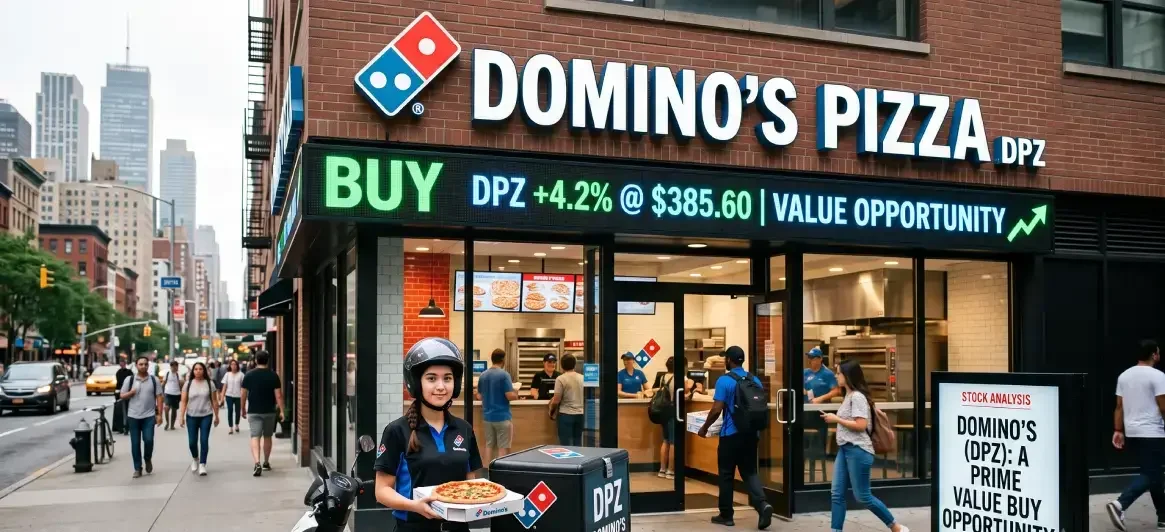
Wall Street is notorious for its short-term memory. When a sector falls out of favor, the market tends to punish the entire industry indiscriminately, throwing the baby out with the bathwater. Currently, the restaurant sector—and the pizza delivery segment in particular—is experiencing a profound cooling period. Driven by shifting consumer tastes toward chicken and Mexican food, the aggressive rise of third-party delivery apps like DoorDash, and abrupt C-suite transitions, the narrative surrounding the pizza industry has turned decisively bearish.
This perfect storm of macroeconomic headwinds has driven shares of Domino’s Pizza (DPZ) down nearly 40% from their recent 52-week highs. As of mid-2026, the stock has taken a significant hit, hovering at valuation levels that have seasoned value investors paying very close attention. The pizza may have gone cold, but the underlying mechanics of Domino’s business model are generating undeniable heat.
This massive selloff has created a generational Domino’s Pizza value buy opportunity. By analyzing the company’s bargain valuation, its historical performance during economic recessions, and its unassailable position as an industry consolidator, it becomes clear that Domino’s is not just surviving a downturn—it is actively weaponizing it against the competition.
The Fundamental Thesis: A Bargain Valuation in a Shrinking Pie
The most compelling argument for initiating a position in Domino’s today begins with its valuation. The recent stock price correction has pushed DPZ down to trade at approximately 16 times earnings. To put this into historical context, this is a depressed multiple that the company has not seen since the darkest days following the 2008–2009 Great Financial Crisis.
When compared to its direct industry peers, this valuation discrepancy becomes glaring. Heavyweights like McDonald’s and Yum! Brands are currently trading around 20 times forward earnings. This means that Domino’s is fundamentally mispriced relative to its sector. At a 16x multiple, Domino’s does not need to engineer hyper-growth or execute a miraculous turnaround to generate stellar returns for patient shareholders; it simply needs to maintain its operational cadence.
Winning the War of Attrition
The broader narrative that “the pizza market is shrinking” is technically true, but it misses a critical nuance: while the overall pie (all pun intended) may be getting smaller, Domino’s is aggressively taking a larger slice of what remains. This is a classic war of attrition, and Domino’s is the only combatant armed with infinite ammunition.
Competitors are already waving the white flag. Yum! Brands recently sold off Pizza Hut, Papa John’s has openly floated the possibility of a sale, and countless midsize regional chains are quietly closing their doors, unable to sustain the margin pressures of inflation and third-party delivery fees. Yet, amidst this carnage, Domino’s is fundamentally expanding. Even if their net new store growth experiences a slight deceleration, they are
consistently adding locations and capturing orphaned customers while their biggest rivals shrink into obsolescence.
The Asset-Light Cash Machine
What truly separates Domino’s from a standard casual dining stock is its capital structure. Domino’s operates an “asset-light” franchise model. Corporate operations require very little capital expenditure to run because the franchisees themselves shoulder the vast majority of the costs associated with funding and opening new store locations.
This structural brilliance frees up literal mountains of cash. Last year alone, Domino’s free cash flow surged to a staggering $672 million. Because the corporate entity does not need to reinvest this cash into building physical restaurants, that capital is highly liquid. Management aggressively returns this capital to shareholders through a combination of robust dividends (2.67% yield) and aggressive stock buybacks. When a company with $672 million in free cash flow buys back its own stock at a depressed 16x multiple, it creates a powerful compounding effect that heavily rewards early investors.
The “Last Man Standing” Strategy: Historical Parallels
To fully understand the magnitude of the Domino’s Pizza value buy opportunity, we must look outside the pizza industry. In business theory, what Domino’s is executing is known as the “Last Man Standing” or “Consolidator” strategy.
Counterintuitively, when a sector begins to shrink, it actually becomes less competitive over time. Weaker companies run out of cash, panic, severely discount their products to drive foot traffic, destroy their own profit margins, and eventually file for bankruptcy. The dominant player, conversely, does not need to innovate drastically or launch expensive new product lines. They simply have to outlast everyone else. Once the competition perishes, the sole survivor scoops up the remaining demand, slashes capital spending, and transitions into a highly profitable cash machine.
History is replete with examples of companies that generated massive, market-beating stock growth precisely while their broader industries collapsed around them.
1.) The Restaurant Parallel: Texas Roadhouse (TXRH)Over the last 15 years, the mid-tier casual dining sector (the traditional “bar and grill”) has faced a brutal, secular decline. Chains like Ruby Tuesday, TGI Fridays, and Applebee’s closed hundreds of locations as consumers pivoted toward fast-casual options like Chipotle or delivery apps.
However, Texas Roadhouse (TXRH) emerged as the Last Man Standing. While its peers panicked and relied on desperate discount promotions, Texas Roadhouse leaned heavily into its operational scale, maintained high-volume dining rooms, and strictly refused to use third-party delivery apps. By executing flawlessly while the competition starved, they captured the remaining casual dining audience. Their stock soared, becoming one of the
greatest restaurant success stories of the decade, entirely built upon the ashes of their competitors.
2.) The Retail Parallel: Best Buy (BBY)
In the early 2010s, Wall Street assumed Amazon would entirely eradicate physical brick and-mortar electronics stores. For the most part, they were right: Circuit City, RadioShack, CompUSA, and HHGregg all went bankrupt. In 2012, Best Buy’s stock crashed below $15 a share, and analysts were busy writing its obituary.
But with all its direct competitors dead, Best Buy inherited 100% of the consumers who still wanted or needed to physically interact with electronics. They leveraged this absolute monopoly on floor space to force vendors like Apple and Samsung to pay them for retail placement, and turned their surviving stores into regional shipping hubs. By simply outlasting the “retail apocalypse,” Best Buy went on a massive, multi-year bull run.
3. The Ultimate Historical Example: Altria (MO)
Perhaps the absolute gold standard for the argument regarding Domino’s is Altria, the maker of Marlboro cigarettes. U.S. smoking rates and cigarette sales volumes have been steadily declining every single year since the 1960s. Yet, Altria is historically one of the best-performing stocks of all time.
Because the tobacco industry was shrinking and heavily regulated, no new competitors could enter the space. Altria held a near-monopoly on a shrinking pie. Because they didn’t need to build new factories or run massive growth campaigns (advertising was eventually banned), their capital expenses dropped to near zero. They used their immense scale to incrementally raise prices on the remaining, highly loyal consumer base. The result was
literal mountains of free cash flow poured directly into dividends and stock buybacks. They generated unprecedented wealth entirely within a dying industry.
The Takeaway: If Domino’s executes this playbook, the bet is that Pizza Hut, Papa John’s, and independent mom-and-pop shops will continue closing. Domino’s will inherit the remaining baseline pizza demand with virtually zero new capital investment required, turning that dominance into aggressive shareholder returns.
The Lipstick Effect: Unmatched Recession Resilience
Beyond its valuation and consolidator status, the final pillar of the Domino’s Pizza value buy thesis is its unique behavior during macroeconomic downturns. Simply put, Domino’s is the ultimate recession-resistant restaurant stock.
In consumer economics, there is a behavioral phenomenon known as the “lipstick effect.” When household budgets tighten and the economy sours, consumers instinctively cut out big-ticket luxuries—like fine dining, expensive vacations, or new cars—but they still crave affordable comforts. They refuse to give up all indulgences. When money gets tight, families swap an $80 sit-down restaurant tab for a $20 Domino’s pizza night. It feels like a treat, bringing joy to the family, but it actually represents a significant trade-down in their overall spending.
People don’t just buy pizza during a recession; they rely on it as a budget-friendly emotional lifeline. Because of this built-in value proposition, Domino’s behaves much more like a consumer staple (akin to groceries or utility companies) than a discretionary restaurant stock. It consistently outperforms the broader hospitality and casual dining sectors when the economy contracts.
Analyzing the Last Three Recessions
The historical data proves this thesis unequivocally. Recessions act as an accelerant for Domino’s specific market segment.
- The Early 2000s Recession (March 2001 – November 2001): Although Domino’s was still a private company during this period, the data paints a clear picture. While the dine-in restaurant segment shrank by 3.4%, the pizza delivery market grew at a 7.6% annual clip (Technomic, 2002; PMQ Pizza Magazine, 2002). Domino’s generated record system-wide sales of $3.8 billion (Domino’s Pizza IPO prospectus (2004)), capturing 19% of the total U.S. pizza delivery market by year’s end.
- The Great Recession (December 2007 – June 2009): The initial 2008 shock hurt everyone, and Domino’s saw domestic same-store sales briefly dip around 3%. However, while casual dining chains faced mass bankruptcies, Domino’s leaned out its operations, repurchased debt, and kept international sales growing. By the fourth quarter of 2009—coinciding with their famous “Pizza Turnaround” recipe overhaul—their adjusted earnings per share (EPS) exploded by 58%. While the S&P 500 lost 57% peak-to-trough,
DPZ established its all-time bottom and subsequently launched a legendary decade-long bull run. - The COVID-19 Recession (February 2020 – April 2020): This brief but brutal recession triggered an unprecedented restaurant wipeout. Yet, Domino’s was already the ultimate “stay-at-home” stock. In fiscal 2020, global retail sales jumped 10.4%, U.S. same-store sales surged 11.5%, and their EPS skyrocketed nearly 30% to $12.39. They required zero operational pivots and captured massive market share from crippled competitors.
To highlight the difference: In a “normal” booming economy, Domino’s relies on steady, mid single-digit same-store sales growth (3% to 5%). But during a recession, as seen in 2020, same-store sales growth can push well past 11%. Recessions supercharge their unit economics.
A Rare Window for Value Investors
As we navigate the mid-2026 economic landscape, consumer confidence is sitting at pandemic-era lows, and macro headwinds are undeniably swirling. Competitors are aggressively imitating Domino’s value promotions, causing short-term pricing pressure. This has understandably resulted in DPZ stock taking a 40% hit from its recent peaks.
However, “recession-resistant” does not mean a stock is immune to all market cycles or sector rotations. What matters is the underlying business. Despite the stock price correction, Domino’s underlying EPS remains incredibly robust at over $4 per quarter. The core unit economics of their franchise model remain highly resilient.
For investors willing to look past the immediate negative headlines, the setup is extraordinarily rare. You are presented with the opportunity to buy the undisputed market leader in a consolidated space, trading at a 14-year low valuation multiple of 16x forward earnings, backed by an asset-light model generating $672 million in free cash flow, with a historically proven track record of supercharged performance during economic recessions.
The pizza industry might be cooling down, but for those who recognize the mechanics of the Last Man Standing, Domino’s Pizza might very well be a blazing hot value buy.




Leave a Comment
You must be logged in to post a comment.