
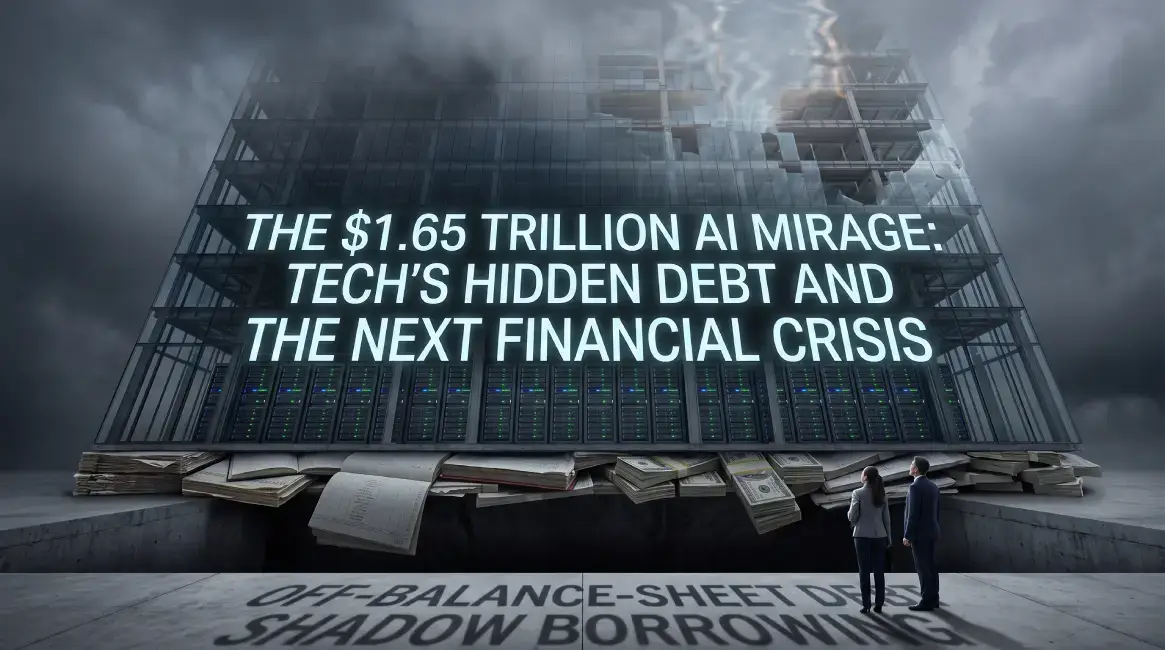
Silicon Valley is building the future on a foundation of hidden leverage. A gold rush mentality has overtaken the technology sector, driving unprecedented investment into artificial intelligence infrastructure. Yet, the financial mechanics funding this explosion of data centers and processors remain obscured from the public markets.
According to a Nikkei Asia investigation, Major technology corporations—specifically Amazon, Alphabet, Meta, Microsoft, and Oracle—are currently sitting on an estimated $1.65 trillion in off-balance-sheet debt. This staggering financial obligation is entirely tied to artificial intelligence initiatives, primarily long-term data center leases and graphics processing unit (GPU) acquisitions. In just four years, the volume of this hidden debt has surged eightfold.
To understand the sheer scale of this liability, one only needs to look at the official ledgers. This $1.65 trillion in unrecorded obligations now completely overshadows the $1.35 trillion in formal debt these companies actively report on their balance sheets. Investors, regulatory bodies, and financial analysts are effectively flying blind, unable to accurately assess the true financial commitments these corporations are making in their desperate race for artificial intelligence dominance.
The Architecture of Shadow Borrowing
The Bank for International Settlements has formally labeled this maneuver “shadow borrowing”. It is a sophisticated corporate sleight of hand. Rather than buying land, laying specialized power infrastructure, and purchasing server racks outright, technology giants are utilizing multi-year lease agreements with external data center operators. Current accounting standards dictate that these massive financial commitments remain entirely off the balance sheet until the specific assets become fully operational. The result is a financial black hole.
The primary vehicle for this obfuscation is the Special Purpose Vehicle (SPV). When a new data center project is greenlit, a separate corporate entity is established specifically to hold the debt and manage the developmental risk. The technology company acts as the anchor client, committing to long-term usage agreements while keeping the construction liabilities off its own books.
Meta provides a textbook example of this capital strategy. The social media giant formed a joint venture with investment funds managed by Blue Owl Capital to construct a massive data center facility in Louisiana. The project’s total investment is projected to exceed $50 billion. Meta holds only a minority stake in the operating company. This structure allows the corporation to secure vast computing capacity without immediately recording the full, multi-billion-dollar financial burden as direct debt. Consequently, Meta carries an estimated $420 billion in hidden debt, a figure almost three times higher than its official reported obligations.
Oracle has embraced this strategy with equal aggression. The company’s hidden debt has multiplied roughly thirty times over the past four years, reaching $273.3 billion by the end of May. This rapid expansion is heavily tied to ambitious infrastructure projects, including the massive Stargate AI data center built in collaboration with OpenAI, which is facilitated entirely through long-term lease arrangements with external operators.
Echoes of the 2008 Financial Crisis, and Enron?
The mechanics of this shadow borrowing bear a chilling resemblance to the financial instruments that catalyzed the 2008 global economic collapse. The modern equivalent of the collateralized debt obligation (CDO) is the AI data center SPV. Both instruments serve to package massive amounts of risk, remove it from the primary corporate balance sheet, and sell it to institutional investors seeking reliable yields. One could even draw comparisons to Enron, the company used hundreds of Special Purpose Entities (SPEs) to execute obscured financial maneuvers. Enron was able to project an image of profitability and maintain credit ratings by using the SPEs to borrow money (which never appeared on the balance sheet); the company would also transfer underperforming assets, bad investments, and/or massive financial liabilities directly into these SPEs.
The truly alarming element is the ultimate source of this capital. These Special Purpose Vehicles are not primarily funded by traditional commercial banks; they are financed heavily through the private credit market. This multi-trillion-dollar shadow banking ecosystem is sustained by institutional capital. The ultimate financiers of this speculative hardware boom are teachers’ pensions, municipal retirement accounts, and conservative insurance funds. The Securities and Exchange Commission has largely failed to regulate this specific intersection of private credit and technology infrastructure. Everyday citizens are unknowingly underwriting the most aggressive corporate hardware buildout in modern history.
If these data centers fail to generate the necessary revenue to service their debt, the SPVs have no financial recourse. They are entirely dependent on their single corporate client. If a tech giant breaks its lease or if the AI demand falters, the investors holding the private credit will absorb the entirety of the loss.
The Mathematics of a Bubble
The underlying financial models supporting this buildout are showing severe signs of strain. Global investment in artificial intelligence reached a staggering $800 billion in 2025 alone. This influx of capital was fueled heavily by mega-rounds of venture capital funding that frequently exceeded $100 million. Total venture capital funding in the space nearly doubled to $226 billion.
Despite this historic capital injection, the industry faces an insurmountable mathematical reality. To support the planned 130 gigawatts of IT load currently in the global pipeline, the technology sector would need to generate approximately $1.68 trillion in annual compute revenue.
The current market is nowhere near that capacity. Actual demand for artificial intelligence computing is estimated to be between $100 billion and $120 billion a year. The gap between infrastructure expenditure and actual commercial demand is catastrophic. While the SenseAI Ventures report notes a pivot toward deploying AI in revenue-generating software applications, the application layer is currently failing to produce the necessary cash flow to justify the hardware costs.
Cracks in the Foundation: Earnings Reality
Corporate earnings reports are beginning to reflect the immense financial pressure of this infrastructure race. The facade of infinite growth is fracturing under the weight of capital expenditures.
Alphabet recently posted what appeared to be an impressive quarter but the vast majority of earnings came from paper gains on their Anthropic shares. Corporate revenue jumped 24% year-over-year. The Google Cloud segment surged by a remarkable 82% from the previous year. However, the aggressive push into AI infrastructure is rapidly depleting the company’s cash reserves. Free cash flow plunged into negative territory for the first time, hitting a deficit of $5.9 billion. Simultaneously, capital expenditure guidance for 2026 was aggressively revised upward to $205 billion. The market recognized the unsustainable nature of this spending, sending the stock down more than 4% during after-hours trading. If end-user demand for AI slows, Alphabet will be left holding hundreds of billions of dollars in rapidly depreciating assets.
Tesla is experiencing a similar identity crisis. The automotive company beat revenue expectations, posting a 26% year-over-year increase, and reported a 25% jump in first-quarter delivery numbers. However, profitability slipped by 5%, and free cash flow dropped to a negative $1.1 billion. Wall Street punished the stock, sending it tumbling 25% from its recent peak.
Tesla’s core problem is a lack of fundamental product innovation. The company is heavily reliant on an aging vehicle lineup that utilizes the same platform launched nearly a decade ago. Instead of refreshing its primary revenue driver, leadership is directing immense capital and engineering focus toward speculative artificial intelligence projects, specifically autonomous robotaxis and humanoid robots. This shift in focus has coincided with a severe talent drain, as key engineers depart for other ventures like SpaceX.
The Economic Fallout: What Happens Next?
The technology sector is currently trapped in a game of financial musical chairs. Corporations are betting that artificial intelligence will unlock unprecedented waves of global productivity. But if the commercial demand plateaus, the economic fallout will cascade far beyond Silicon Valley.
Based on the trajectory of this shadow borrowing, the global economy is facing three unique and highly probable systemic shocks.
The Private Credit Freeze: The most immediate crisis will hit the shadow banking sector. When AI software revenue fails to cover the $1.68 trillion required to maintain the global data center footprint, tech companies will be forced to renegotiate or abandon their SPV leases. Because these vehicles rely on non-recourse loans, the private credit funds will take the direct hit. Pension funds and insurance companies will face severe write-downs, triggering a liquidity crisis in the private markets. Credit will freeze, abruptly ending the era of easy financing for enterprise technology.
The Great Hardware Deflation: Data centers are not general-purpose real estate. They are highly specialized facilities filled with computing equipment that becomes obsolete within three to five years. If demand collapses, the market will experience a historic fire sale. Hundreds of billions of dollars in graphics processing units will flood the secondary market. This extreme oversupply will crush hardware margins, devastating the valuations of semiconductor manufacturers and equipment suppliers who have relied on infinite demand projections.
Regulatory Overcorrection: The eventual exposure of $1.65 trillion in hidden debt will force aggressive government intervention. Just as the 2008 crisis birthed sweeping banking reforms, the collapse of AI infrastructure SPVs will trigger severe SEC crackdowns on off-balance-sheet accounting. Technology companies will be forced to internalize their debt, instantly degrading their credit ratings, drastically increasing their cost of borrowing, and effectively ending the “growth at all costs” era of the modern internet.
Silicon Valley has engineered an infrastructure miracle over the last four years. But it was built on a foundation of shadow debt, subsidized by retirement funds, and sustained by an illusion of infinite demand. The bill for the future is coming due, and the balance sheet is largely empty.

Leave a Comment
You must be logged in to post a comment.