

Market participants continually seek an informational advantage to generate consistent returns in increasingly complex environments. Financial markets reward precision, structural understanding, and execution speed, aggressively penalizing those reliant on delayed reporting or surface-level commentary.
Banting Court Capital offers a specialized suite of premium services precisely designed to equip market participants with that essential edge. Through a combination of rigorous corporate financial analysis, proprietary data models, and direct access to institutional dialogues, we provide a comprehensive framework for market evaluation. The platform shifts focus away from standard retail metrics, offering professional-grade tools designed to extract actual, actionable signals from daily market noise.
Premium Articles
Information asymmetry defines the spread between professional returns and retail losses. Our premium articles deliver frequent, detailed breakdowns of corporate financial health along with overlooked market trends. These reports evaluate balance sheets, debt structures, and fundamental metrics to separate viable companies from those operating on borrowed time. Analysts prioritize raw numbers, specifically tracking quick ratios and dividend payout cash flows, to determine a corporation’s ability to withstand sustained periods of elevated borrowing costs or revenue compression.
The focus remains heavily weighted on structural reality rather than executive forecasts. Furthermore, these long-form pieces dissect complex equity derivatives behavior and institutional trading strategies. By understanding how large funds position their portfolios for upcoming quarters, readers may align their own capital with the dominant market current rather than fighting structural flows.
Market Data & Analysis
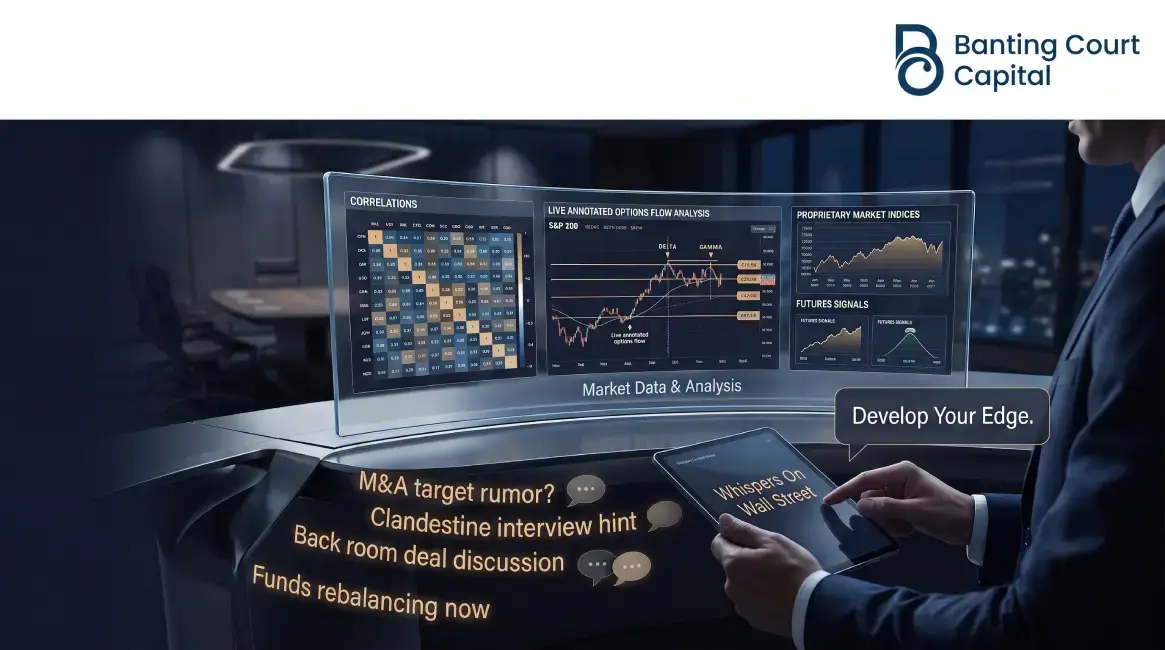
Retail participants operate at a structural disadvantage when relying solely on basic price charts. We counter this imbalance through our “Market Data & Analysis” tier, which heavily scrutinizes financial market plumbing. The service provides proprietary indices and tracks live market correlations to map exactly how shifts in bond yields or currency values bleed into domestic equity valuations.
Core components of this service focus on S&P 500 (SPY) options flow, dealer positioning, unusual market data, and historic trends analysis. The platform compiles daily aggregates of dealer delta data, tracking structural shifts across consecutive weeks. This data reveals the specific price levels where market makers are forced to hedge their books by either buying or selling the underlying asset. By isolating these gamma levels and identifying directional conclusions based on SPY market DEX data, subscribers can anticipate periods of compressed volatility or sudden expansion. Our “Arctic Char” futures trading signals are then overlaid onto this data, providing distinct, mathematically defined entry and exit parameters based on momentum.
Intraday Trader Texts
Market conditions rarely accommodate rigid daily plans. When major economic data prints or sudden geopolitical events hit the wire, price action accelerates, forcing immediate portfolio re-evaluations. The “Intraday Trader Texts” service bridges the divide between static morning analysis and the realities of live market execution. Subscribers receive market updates and direct trading signals pushed directly to their mobile devices.
These alerts highlight immediate technical breakdowns in key benchmark indices, sudden shifts in trading volume, and unusual options activity occurring beneath the surface. If institutional participants aggressively unload specific asset classes in response to an intraday interest rate shock, the text service immediately broadcasts that specific directional shift. It serves as an ongoing, unfiltered feed of market plumbing adjustments. This ensures active participants remain perfectly calibrated to the live tape, eliminating the necessity of remaining tethered to multiple desktop data terminals throughout the entire trading session.
Whispers On Wall Street
Regulatory filings and official press releases only represent the final stage of institutional maneuvering. Our “Whispers On Wall Street” service aggregates qualitative intelligence, capturing the untelevised dialogues that dictate future capital flows. This service compiles overheard conversations, speculation regarding back room deals, and direct interviews from insiders operating across Wall Street.
Institutional capital requires time and liquidity to position itself. The discussions circulating among analysts, Wall Street execs (current and former), and large-scale block traders frequently foreshadow future mergers, acquisitions, and surprise capital raises weeks before they cross official public news wires. Whispers On Wall Street tracks this shifting sentiment of institutional operators. Monitoring these quiet communications allows market participants to position themselves ahead of major institutional portfolio rebalancing, completely avoiding the risk of serving as exit liquidity for larger funds.
Looking Ahead With an Edge
Achieving consistent returns requires superior data, precise execution, and an accurate read of underlying market mechanics. Banting Court Capital strips away the noise associated with retail investing, replacing it with institutional-grade intelligence and hard financial realities. The continuous integration of intraday signals, structural options analysis, and direct Wall Street sourcing constructs a highly effective framework for market participants at just $15/month.
Whether navigating sudden volatility in small cap equities, evaluating prospective corporate credit events, or tracking the options flow of the broader S&P 500, Banting Court Capital guarantees its subscribers possess the specific data necessary to maintain a defined edge in the market. Subscribers operate with the assurance that their knowledge base is filled with absolute data and insider context, rather than delayed reactions to public narratives.





Leave a Comment
You must be logged in to post a comment.